Brass
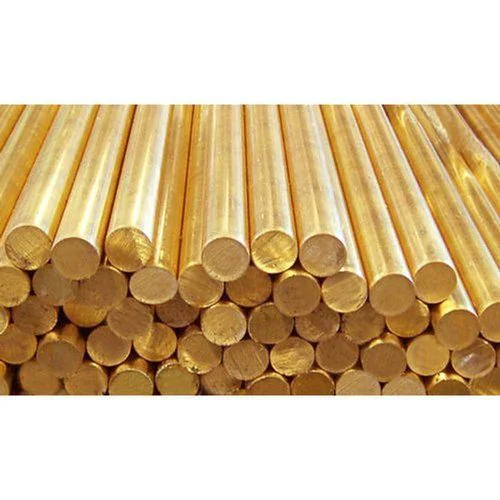
Some of the common types of brass available include:
- Red brass
- Yellow brass
- 330 brass
- 360 brass
- 464 brass
Other properties of brass include the following
- Muted yellow/gold color (depending on the amount of zinc)
- High corrosion resistance (especially if it contains an above-average amount of
manganese)
- Susceptibility to cracking from excessive stress
- Highly castable
- Above-average thermal conductivity
- Non-ferromagnetic (making it easier to separate for recycling)
Brass finds application across a wide range of industries, such as:
- The brighter, gold-looking appearance of brass makes it an excellent choice for
decorative applications.
- Musical instruments. Its workability and durability make it a
highly suitable source material for musical instruments (e.g., guitar strings)
- Plumbing pipes and tubing. The high corrosion resistance
demonstrated by brass makes it suitable for plumbing applications.
- Similar to bronze, brass is used in electronic applications, due to its excellent
electrical conductivity.
| Property |
Value |
| Chemical Symbol |
Brass is an alloy, primarily composed of copper (Cu) and zinc (Zn) |
| Composition |
Typically, brass contains around 60-80% copper and 20-40% zinc, with small
amounts of other elements such as lead, aluminum, or tin for specific
properties. |
| Density |
Varies depending on the specific composition of the alloy, typically ranges
from 8.4 to 8.7 g/cm³ |
| Melting Point |
Varies depending on the composition, typically between 900°C to 940°C
(1652°F to 1724°F) |
| Young's Modulus |
90–110 GPa (for common brass alloys) |
| Shear Modulus |
33–40 GPa (for common brass alloys) |
| Bulk Modulus |
100–140 GPa (for common brass alloys) |
| Poisson's Ratio |
0.33–0.36 (for common brass alloys) |
| Tensile Strength |
290–620 MPa (for common brass alloys) |
| Yield Strength |
150–450 MPa (for common brass alloys) |
| Elongation at Break |
10–40% (for common brass alloys) |
| Hardness (Brinell) |
65–230 HB (for common brass alloys) |
| Electrical Conductivity |
Brass has good electrical conductivity, typically around 23–45 MS/m
(megaSiemens per meter) depending on the alloy composition and condition.
|
| Thermal Conductivity |
Varies depending on the composition, typically ranges from 100 to 130
W/(m·K) (Watts per meter-Kelvin) for common brass alloys. |
Notes :
- The properties of brass can vary significantly depending on the specific composition
of the alloy, including the percentage of copper, zinc, and any additional elements.
- Different brass alloys are engineered for specific applications, with variations in
properties such as strength, corrosion resistance, machinability, and appearance.
- Brass is valued for its combination of properties, including its attractive
appearance, corrosion resistance, malleability, and ease of machining.
- Common applications of brass include decorative items, musical instruments, plumbing
fittings, electrical connectors, and various industrial components.

 Pipes &
Tubes
Pipes &
Tubes Sheets
&
Plates
Sheets
&
Plates
 Flanges
 Buttweld
Fittings
Buttweld
Fittings
 Socket
Weld & Threaded Fittings
Socket
Weld & Threaded Fittings
 Fasteners